What is Polydextrose?
A comprehensive guide to polydextrose — its production, functional properties, and applications as a soluble dietary fiber and bulking ingredient in bakery, dairy, beverages, and reduced-sugar formulations.
Soluble fiber and bulking agent for food formulations
Polydextrose is a synthetic soluble dietary fiber widely used in the food industry as a bulking agent, texture modifier, and fiber ingredient. It is produced by the controlled polymerization of glucose with small amounts of sorbitol and an approved food-grade acid catalyst. The resulting polymer has a randomly bonded structure that is only partially digested in the human small intestine, allowing it to function as a dietary fiber in many jurisdictions, subject to applicable regulatory definitions.
Because of its neutral taste, high solubility, low viscosity, and excellent stability during food processing, polydextrose is incorporated into a wide variety of food and beverage products. It is commonly used in bakery products, dairy products, confectionery, beverages, nutritional products, dietary supplements, and reduced-sugar or reduced-calorie formulations.
Aspire Biozymes supplies food-grade Polydextrose suitable for industrial food manufacturing.
What is polydextrose?
Polydextrose is a randomly bonded glucose polymer manufactured through a carefully controlled thermal polymerization process.
Unlike native starch or naturally occurring polysaccharides, polydextrose contains a mixture of glycosidic linkages that are not readily hydrolyzed by human digestive enzymes. Commercial polydextrose is supplied as a free-flowing powder or concentrated liquid and is valued for its versatility in a broad range of food applications.
Raw materials used
Commercial polydextrose is manufactured using food-grade ingredients processed under controlled manufacturing conditions.
- Glucose
- Sorbitol
- Food-grade organic acid catalyst (commonly citric acid)
Production
Production of commercial polydextrose
Commercial production involves several carefully controlled stages.
- Ingredient preparation — glucose, sorbitol, and catalyst blended in predetermined proportions
- Thermal polymerization — controlled heating polymerizes glucose into complex carbohydrate structure
- Neutralization — reaction mixture neutralized for desired product characteristics
- Purification — filtration, decolorization, removal of low-molecular-weight components, and concentration
- Drying — spray-dried powder or liquid grades for industrial applications
Chemical structure
Polydextrose is composed primarily of glucose units connected through a complex network of randomly distributed glycosidic bonds.
Unlike starch, which mainly contains α-(1→4) and α-(1→6) linkages, polydextrose contains a broader range of bond types created during polymerization. This random structure contributes to its resistance to digestion and its functional performance in food systems.
Functional properties
Polydextrose offers several technological advantages for food manufacturers.
Soluble dietary fiber
Widely used as a soluble dietary fiber ingredient in food formulations.
Bulking agent
Provides bulk and body where reductions in sugar or fat may affect texture or volume.
Neutral taste
Mild, neutral taste suitable for products where flavor should remain unchanged.
Low viscosity
Forms low-viscosity solutions even at relatively high concentrations.
Water solubility
Dissolves readily in water and is compatible with a wide range of food ingredients.
Processing stability
Generally stable during heat treatment, pasteurization, and baking depending on formulation.
Food applications
Polydextrose is used in numerous food and beverage categories for fiber enrichment, bulking, and texture modification.
Dairy Products
Yogurt, dairy desserts, ice cream, frozen desserts, and milk-based beverages.
Explore dairyBeverages
Nutritional beverages, functional drinks, powder beverage mixes, and meal replacement beverages.
Explore beveragesConfectionery
Sugar-free confectionery, reduced-sugar candies, chewing gum, and chocolate products.
Nutritional Products
Protein powders, meal replacement products, nutrition bars, and functional foods.
Explore sports nutritionDietary Supplements
Fiber supplements, powder blends, tablets, capsules, and sachets.
Explore dietary supplementsPlant-Based Foods
Dairy alternatives, plant-based beverages, vegan desserts, and functional food products.
Explore plant-basedAdvantages of polydextrose
Commercial polydextrose provides several formulation benefits. The specific functionality depends on product grade, concentration, and processing conditions.
- Soluble dietary fiber
- Neutral flavor profile
- Excellent water solubility
- Low viscosity
- Bulking functionality
- Broad formulation compatibility
- Good processing stability
- Available in powder and liquid forms
- Consistent commercial quality
Quality parameters
Commercial polydextrose is commonly evaluated against defined specifications. Product specifications vary depending on the intended application.
- Polydextrose content
- Moisture
- Ash
- Appearance
- Solubility
- Bulk density
- pH
- Particle size (powder grades)
- Microbiological quality
- Heavy metal compliance
Storage
Commercial polydextrose should generally be stored in a cool, dry environment, in tightly sealed packaging, protected from moisture and direct sunlight, according to the manufacturer's storage recommendations.
Regulatory considerations
Polydextrose used in food products should comply with applicable regulations concerning food ingredient standards, dietary fiber definitions, food safety requirements, Good Manufacturing Practices (GMP), ingredient labeling requirements, and country-specific regulatory requirements.
Related products & guides
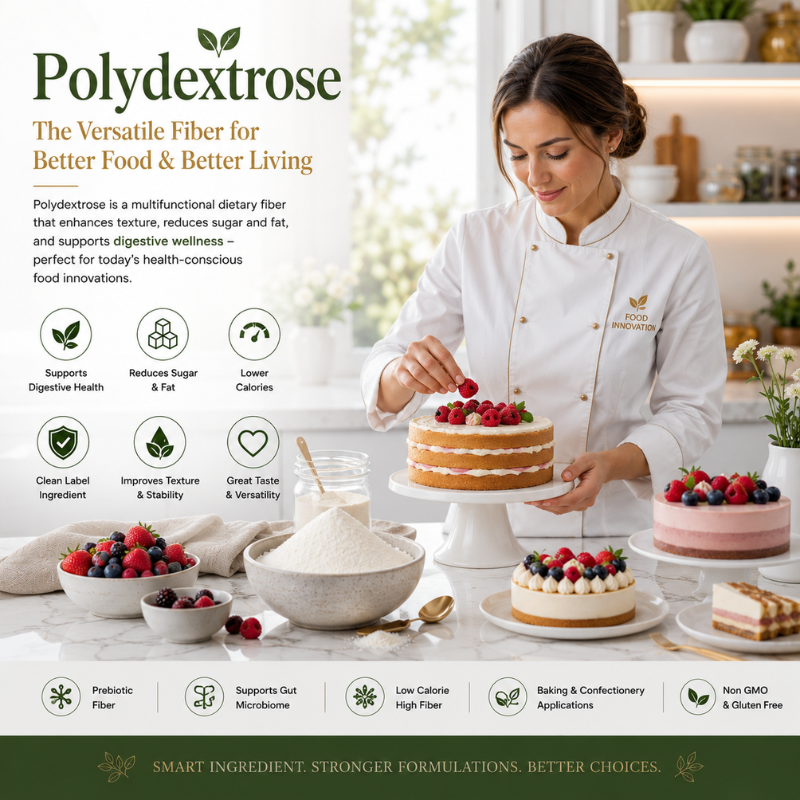
Polydextrose
View product page
Inulin
View product page
What is Resistant Dextrin?
Read the guide
What are Fructooligosaccharides (FOS)?
Read the guide
Soluble Dietary Fiber
Read the guideScientific summary
Polydextrose is a synthetic soluble dietary fiber produced by the controlled polymerization of glucose with small amounts of sorbitol and a food-grade acid catalyst.
Due to its neutral taste, excellent solubility, low viscosity, and processing stability, polydextrose is widely used in bakery products, dairy foods, beverages, confectionery, nutritional products, dietary supplements, and plant-based foods.
It also functions as a bulking agent and texture modifier in a wide range of food formulations.
Frequently asked questions
Polydextrose is a synthetic soluble dietary fiber produced by polymerizing glucose with small amounts of sorbitol and a food-grade acid catalyst under controlled conditions.
Commercial polydextrose is manufactured through thermal polymerization, followed by neutralization, purification, and drying to produce powder or liquid products suitable for food applications.
Polydextrose is widely used in bakery products, dairy foods, beverages, confectionery, nutritional products, dietary supplements, and plant-based foods.
It provides soluble dietary fiber, bulk, texture, low viscosity, neutral taste, and good processing stability, making it useful in a broad range of food formulations.
Polydextrose offers excellent water solubility, bulking functionality, neutral flavor, low viscosity, processing stability, and compatibility with many food ingredients, making it a versatile ingredient for modern food manufacturing.
Ready to formulate with polydextrose?
Explore food-grade Polydextrose and the complete dietary fiber portfolio from Aspire Biozymes.