Dietary Fiber
What Is Dietary Fiber?
Understanding soluble and insoluble fiber — from natural plant sources to functional ingredients used in modern food and nutrition manufacturing.
An essential component of plant-based nutrition
Dietary fiber is an important component of plant-based foods and plays a significant role in modern food and nutrition. Unlike proteins, fats, and digestible carbohydrates, dietary fiber is not completely broken down by human digestive enzymes in the small intestine. Instead, it passes through the digestive tract, where different types of fiber contribute to various physiological and functional properties.
In addition to its role in human nutrition, dietary fiber is widely used in food manufacturing to improve texture, mouthfeel, stability, water retention, and product formulation. As consumer demand for functional foods and plant-based nutrition continues to grow, dietary fiber has become an essential ingredient in beverages, bakery products, dairy alternatives, nutritional supplements, and meal replacement products.
Aspire Biozymes supplies high-quality soluble dietary fibers for diverse food and nutrition applications.
What is dietary fiber?
Dietary fiber refers to the edible carbohydrate polymers and associated plant components that resist digestion and absorption in the small intestine.
Instead of being digested like sugars or starches, dietary fiber moves into the large intestine, where it may undergo partial or complete fermentation depending on the fiber type. Dietary fiber is naturally present in many plant-derived foods and is also available as purified functional ingredients for commercial food manufacturing.
Types of dietary fiber
Dietary fiber is generally classified into two major categories.
Soluble dietary fiber
Soluble fiber dissolves or disperses in water to form a solution or gel-like consistency depending on its structure. Characteristics include high water solubility, excellent formulation versatility, suitability for beverages, and compatibility with nutritional products.
Examples include inulin, fructooligosaccharides (FOS), resistant dextrin, and polydextrose.
Insoluble dietary fiber
Insoluble fiber does not dissolve in water and contributes structural bulk in food products. Natural sources include wheat bran, oat bran, whole grains, vegetable cell walls, fruit skins, and seeds.
Insoluble fibers are commonly incorporated into bakery products, cereals, and whole-grain foods.
Learn more in our soluble vs insoluble fiber guide.
Natural sources of dietary fiber
Many plant foods naturally contain dietary fiber.
Fruits
Apples, pears, bananas, berries, and oranges.
Vegetables
Carrots, broccoli, spinach, green peas, and sweet potatoes.
Legumes
Lentils, chickpeas, kidney beans, black beans, and peas.
Whole grains
Oats, barley, brown rice, whole wheat, and rye.
Nuts and seeds
Almonds, flaxseed, chia seeds, sunflower seeds, and pistachios.
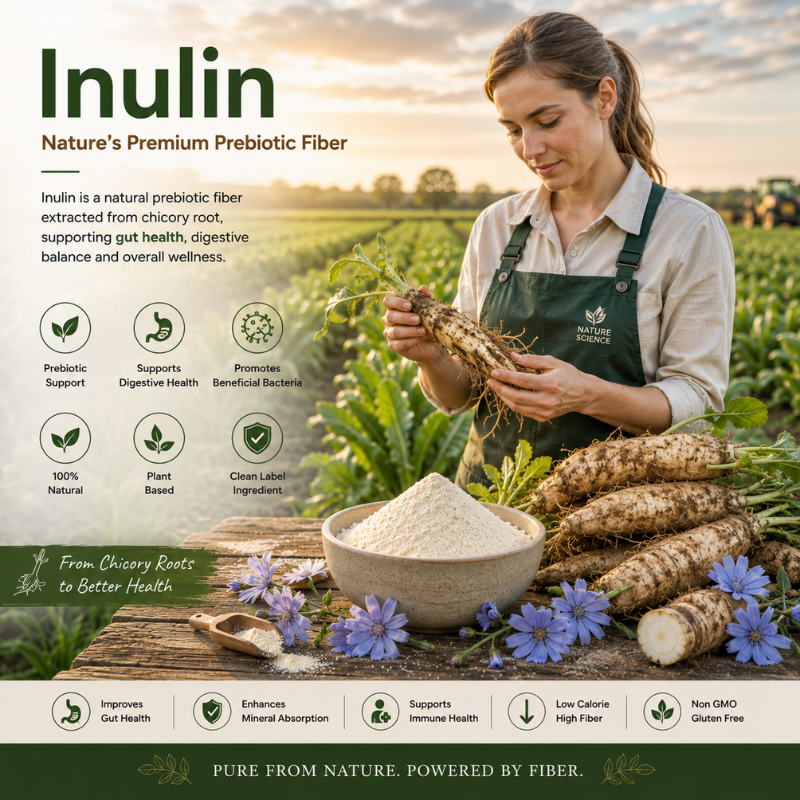
Inulin
Soluble fiber from chicory root
Inulin is a soluble dietary fiber obtained primarily from plant sources such as chicory root. Applications include dairy alternatives, functional beverages, protein powders, meal replacements, and nutrition bars. It is valued for its excellent solubility and ability to contribute body and mouthfeel in certain formulations.
View InulinFructooligosaccharides (FOS)
Short-chain soluble dietary fiber
FOS is a short-chain soluble dietary fiber commonly used in beverage formulations, functional foods, nutritional supplements, and dairy alternatives. Its high solubility makes it suitable for liquid and powdered products.
View FOSResistant Dextrin
High solubility with neutral flavor and low viscosity
Resistant Dextrin is widely used because of its high water solubility, neutral flavor, low viscosity, and excellent beverage compatibility. Applications include clear beverages, functional drinks, nutritional supplements, and meal replacement products.
View Resistant DextrinPolydextrose
Bulking fiber for functional food formulations
Polydextrose is commonly incorporated into functional foods, nutrition bars, reduced-sugar products, meal replacements, and beverage formulations. It contributes dietary fiber while supporting formulation flexibility.
View PolydextroseFunctional properties of dietary fiber
Food manufacturers select dietary fibers not only for nutritional purposes but also for their technological benefits.
Depending on the ingredient, dietary fiber may contribute water binding, improved mouthfeel, texture enhancement, product stability, bulking properties, improved dispersibility, viscosity control, and processing consistency. The functional performance depends on the specific fiber, formulation, and processing conditions.
Applications in food manufacturing
Dietary fiber is widely incorporated into commercial food products across beverages, sports nutrition, bakery, nutrition bars, dairy alternatives, and dietary supplements.
- Functional Beverages
- Sports Nutrition
- Bakery Products
- Nutrition Bars
- Dairy Alternatives
- Dietary Supplements
Applications by product category
Functional beverages
High-fiber drinks, nutritional beverages, meal replacement beverages, and plant-based drinks.
Sports nutrition
Protein powders, recovery products, nutritional beverages, and meal replacements.
Bakery products
Bread, cookies, muffins, cakes, and breakfast products.
Nutrition bars
Protein bars, snack bars, meal replacement bars, and functional nutrition bars.
Dairy alternatives
Plant-based milk, yogurt alternatives, nutritional beverages, and dairy-free desserts.
Dietary supplements
Powder supplements, sachets, capsules, and functional ingredient blends.
Selecting the right dietary fiber
Manufacturers evaluate several factors when selecting a dietary fiber.
Solubility
Different applications require fibers with specific solubility characteristics.
Viscosity
Low- and high-viscosity fibers behave differently during processing and in finished products.
Flavor profile
Neutral-tasting fibers are often preferred for beverages and nutritional formulations.
Processing stability
The selected fiber should remain stable during mixing, heating, pasteurization, drying, and storage.
Product objectives
The desired nutritional profile, texture, processing behavior, and application all influence ingredient selection.
Why Aspire Biozymes?
Aspire Biozymes supplies a portfolio of premium soluble dietary fibers for modern food and nutrition applications.
Our products include inulin, fructooligosaccharides (FOS), resistant dextrin, polydextrose, protein + fiber blends, and customized ingredient systems. We provide technical guidance to help manufacturers select suitable fiber ingredients for food, beverage, dietary supplement, and nutrition applications.
Related guides & products
What is Inulin?
Read the guide
Prebiotics Explained
Read the guide
Functional Ingredients
Explore productsScientific summary
Dietary fiber consists of plant-derived carbohydrate polymers that resist digestion in the small intestine and reach the large intestine largely intact.
It is generally classified as soluble or insoluble based on its behavior in water. Commercial dietary fibers such as inulin, fructooligosaccharides (FOS), resistant dextrin, and polydextrose are widely used in food manufacturing because they provide nutritional value along with important functional properties.
These include improved texture, stability, dispersibility, and formulation flexibility. Fiber selection depends on the intended application, processing requirements, and desired product characteristics.
Frequently asked questions
Dietary fiber is the portion of plant-derived carbohydrates that resists digestion in the small intestine and contributes to the nutritional and functional characteristics of foods.
Soluble fiber dissolves or disperses in water and is commonly used in beverages and nutritional products, while insoluble fiber does not dissolve in water and is often found in whole grains, vegetables, and bran.
Fruits, vegetables, legumes, whole grains, nuts, and seeds are all natural sources of dietary fiber.
Aspire Biozymes supplies inulin, fructooligosaccharides (FOS), resistant dextrin, and polydextrose for food, beverage, and nutrition applications.
Dietary fiber is incorporated to enhance nutritional composition and to provide functional benefits such as improved texture, mouthfeel, water binding, stability, and processing performance.
Ready to select the right dietary fiber?
Explore soluble fibers and protein + fiber blends from Aspire Biozymes.