Dairy Products
Yogurt, drinking yogurt, dairy desserts, ice cream, and frozen desserts.
Explore dairyA comprehensive guide to inulin — its plant sources, production methods, functional properties, and applications as a soluble dietary fiber in dairy, bakery, beverages, and plant-based foods.
Inulin is a soluble dietary fiber naturally found in many plants. It is composed primarily of fructose units linked together to form a type of carbohydrate known as a fructan. Because it is not digested in the upper gastrointestinal tract, inulin is classified as a dietary fiber in many jurisdictions, subject to applicable regulatory definitions.
Commercial inulin is widely used in food and beverage manufacturing because of its functional properties, including its ability to contribute to texture, mouthfeel, and bulk in a variety of formulations. It is commonly incorporated into dairy products, bakery foods, beverages, nutrition bars, dietary supplements, and plant-based products.
Aspire Biozymes supplies food-grade Inulin suitable for industrial food manufacturing.
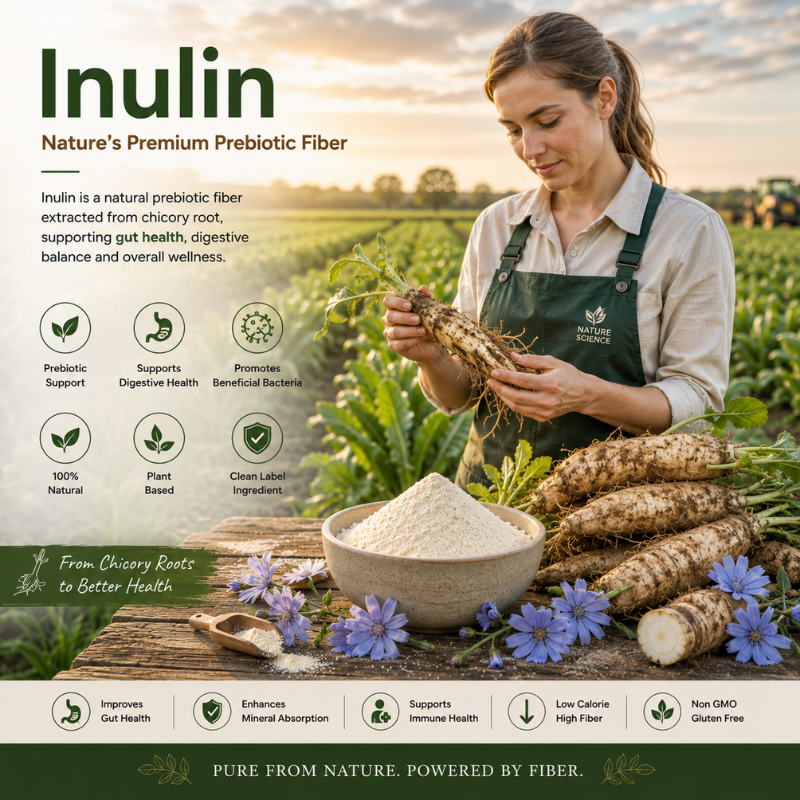
Inulin is a naturally occurring storage carbohydrate found in the roots, tubers, and stems of numerous plant species. It belongs to a group of carbohydrates called fructans, which consist mainly of fructose molecules connected by β-(2→1) glycosidic bonds, typically ending with a glucose unit.
The chain length of inulin varies depending on the plant source and manufacturing process. This variation influences its functional properties in food systems.
Inulin occurs naturally in many edible plants. Among commercial sources, chicory root is the primary source because of its relatively high inulin content and efficient extraction process.
Production
Commercial inulin is produced through controlled extraction and purification from chicory root.
Inulin consists primarily of fructose units with one terminal glucose unit in most naturally occurring forms.
The fructose units are connected through β-(2→1) glycosidic linkages, making inulin resistant to digestion by human digestive enzymes in the small intestine. Its degree of polymerization (DP) varies depending on the source and processing method.
Inulin provides several useful technological functions in food systems. The specific functionality depends on the inulin grade and formulation.
Widely used as a soluble dietary fiber ingredient in food formulations.
Dissolves in water to varying degrees depending on chain length and processing characteristics.
Contributes to texture and mouthfeel in dairy foods, desserts, and bakery products.
Provides bulk in formulations where solid content is required.
Certain grades contribute to creaminess and mouthfeel, allowing partial fat replacement in selected formulations.
May be incorporated into reduced-sugar formulations as a bulking ingredient.
Inulin is widely used across numerous food categories for fiber enrichment and functional formulation.
Yogurt, drinking yogurt, dairy desserts, ice cream, and frozen desserts.
Explore dairyNutritional beverages, functional drinks, powdered beverage mixes, and meal replacement beverages.
Explore beveragesPowder supplements, nutrition blends, fiber supplements, and functional food products.
Explore dietary supplementsDairy alternatives, plant-based desserts, functional beverages, and meat alternatives.
Explore plant-based foodsCommercial inulin offers several formulation advantages for food manufacturers.
Commercial inulin is commonly evaluated against defined specifications. Product specifications vary according to application requirements.
Commercial inulin should generally be stored in a cool, dry environment, in tightly sealed packaging, protected from moisture and direct sunlight, according to the manufacturer's storage recommendations.
Inulin used in food products should comply with applicable regulations concerning food ingredient standards, dietary fiber definitions, food safety requirements, Good Manufacturing Practices (GMP), ingredient labeling, and country-specific regulatory requirements.
Inulin is a naturally occurring soluble dietary fiber composed primarily of fructose units linked by β-(2→1) glycosidic bonds. Commercially, it is most commonly extracted from chicory root through hot water extraction, purification, and drying.
It is widely used in dairy products, bakery foods, beverages, nutrition bars, dietary supplements, and plant-based foods because it contributes soluble fiber, bulk, texture, and formulation flexibility.
Its functional properties depend on factors such as chain length, concentration, and processing conditions.
Inulin is a naturally occurring soluble dietary fiber composed mainly of fructose units. It is commonly extracted from chicory root for use in food manufacturing.
Although inulin occurs naturally in many plants, chicory root is the primary commercial source due to its high inulin content and efficient extraction process.
Inulin is used in dairy products, bakery foods, beverages, nutrition bars, dietary supplements, plant-based products, and functional foods.
Commercial inulin is typically produced through hot water extraction from chicory root, followed by filtration, purification, concentration, and drying.
Inulin functions as a soluble dietary fiber and can contribute to texture, mouthfeel, bulk, and formulation flexibility in a wide range of food applications.
Explore food-grade Inulin and related dietary fiber ingredients from Aspire Biozymes.